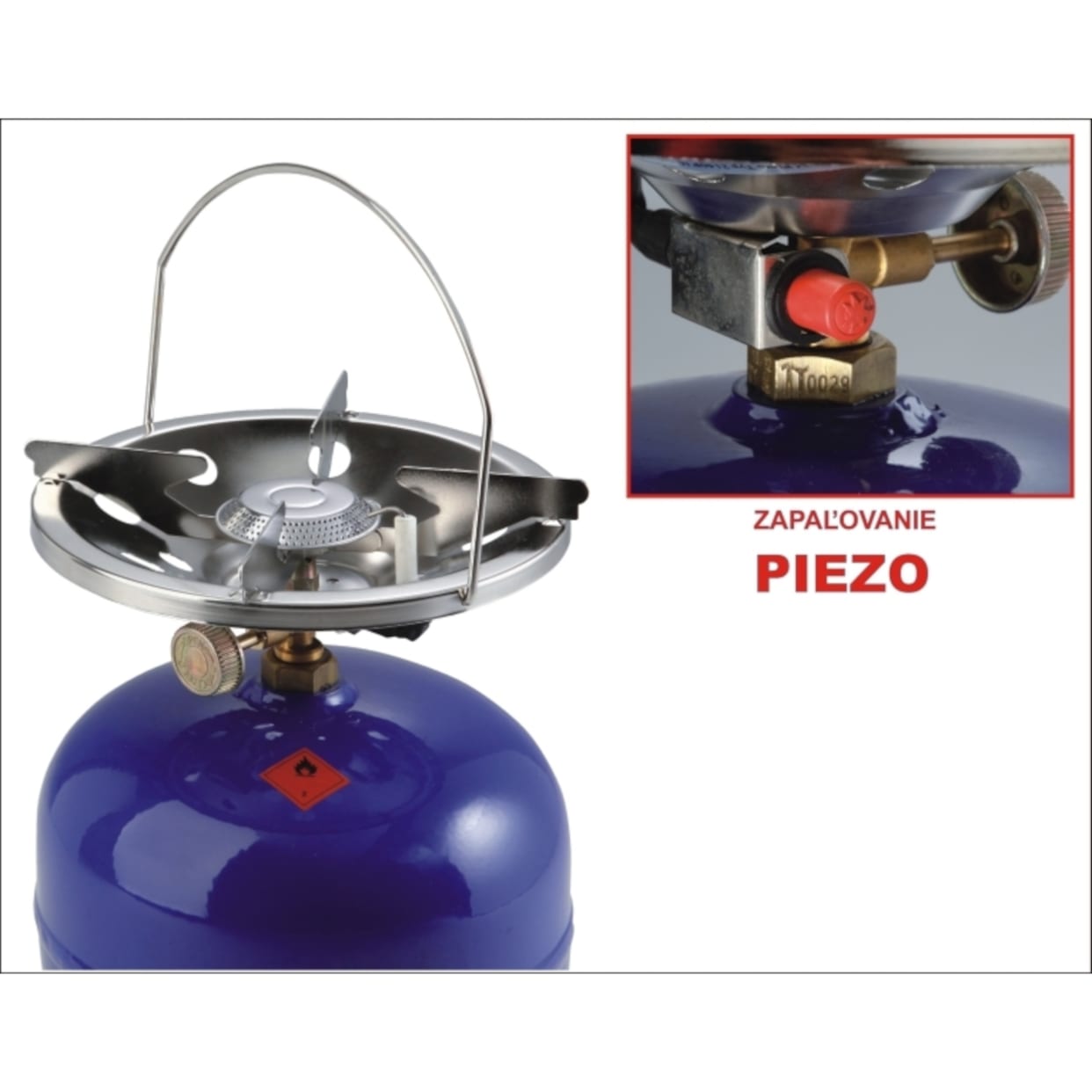
Meva Cooker Magnum
Designed for cooking and heating food. Power 2.1kW, Weight: 0.6 kg, Dimensions: 210x120x210mm, Consumption: 152g / hour, Connection to a 2 kg propane-butane bottle Type: 1421 316 not included.
Camping stove with piezoelectric ignition
The stove will be appreciated by all who love nature. A top-quality stove with electric ignition.
No more searching for a lighter or matches, you won't be surprised by strong winds, with the press of a button when the gas valve is open, the stove is immediately available and you can heat your meals.
The stove is intended for tourist purposes for use in outdoor environments, but also in recreational cabins, caravans, and garden houses for thermal preparation of meals.
Technical parameters:
Source: 2 kg LPG bottle La2 (with a maximum pressure of 1.7 MPa) filled with PB mixture a1 or B
Efficiency: min. 58%
Power: 1350W
Consumption: 78 g / h
Max. allowed load: 7kg
Weight without gas bottle: 0.8 kg
Safety:
- The stove may only be operated by an adult over 18 years of age according to this manual! During the operation of the stove, the operator must also respect general fire safety regulations!
- The stove must not be entrusted to children under any circumstances!
- The stove must be stored out of reach of children!
- Do not use the stove if it has damaged or worn seals!
- Do not use the stove if it is leaking, damaged, or if it is not working properly!
- If your appliance is leaking (smell of gas), immediately move it to an outdoor environment, to a place without open flames with good ventilation, where the leak can be detected and stopped. To check for leaks (tightness) of your appliance, do so in an outdoor environment. Do not check for leaks with an open flame, use a foam solution!
- Accessible parts of the stove (windshield) are very hot during operation and immediately after! Keep small children away from the appliance!
- During operation, the stove must be placed on a non-flammable surface and kept under supervision!
- For fire safety, the stove must be placed at least 500 mm away from flammable materials!
- Perform leak checks in a well-ventilated room or outdoors, away from ignition sources and out of reach of others.
- Replace the LPG bottle in an outdoor environment, away from ignition sources and out of reach of others.
- The surface temperature of the LPG bottle must not exceed 40 °C!
- Direct heating of the LPG bottle to increase the evaporation capacity of the liquid gas is prohibited.
- After connecting the stove to the LPG bottle, avoid tilting, turning, or any manipulation with the LPG bottle that could result in liquid PB mixture flowing into the stove burner. After igniting the burner, due to incomplete ignition of the liquid PB mixture, there could be a significant flare-up of the flame from the burner. After the liquid gas has burned out, the size and intensity of the flame would return to the originally set values. The consequence is clogging of the nozzle (poor combustion), excessive charring of stove components, ash formation, and a greater risk of fire (the resulting flame cannot be controlled)!
- In the area where the stove is in use, ensure adequate ventilation!
- It is prohibited to use the appliance in rooms and areas below ground level!
- For safety reasons, do not modify any parts of the stove!
- It is prohibited to convert the appliance to another type of gas!
- It is prohibited to place and use LPG bottles (even empty) in areas below ground level!
- Use the product only for its intended purpose (e.g. fishing) and follow the manufacturer’s instructions.
- Be careful when handling sharp or small parts (hooks, bait, batteries) and keep them out of the reach of children. Store products in a dry and safe environment, protected from moisture, high temperatures and direct sunlight.
- Avoid using equipment made of conductive materials (rods, landing nets) near power lines or during thunderstorms. Use chemical and toxic materials such as lead only as intended and dispose of them in accordance with local regulations.
- Wash your hands thoroughly when handling products such as bait, lead or batteries. Never tie fishing line around any part of your body to avoid injury.
- Check the condition of your equipment (e.g. rods, reels, lures, connections) and maintain it regularly to ensure its proper function and safety.
- More here: Important information about GPSR regulations.
It might also interest you
More from category